
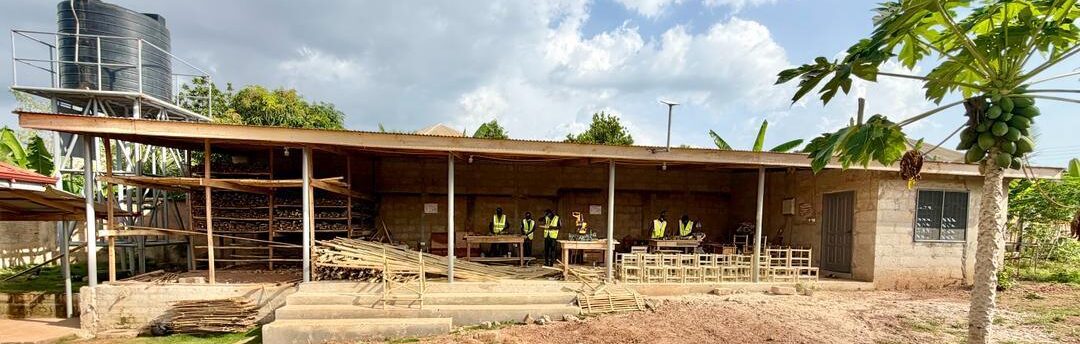
Bambility Workshop
Our solar powered Bamboo Workshop
In our bamboo workshop in Kumasi, completed in mid-April 2026, the raw material bamboo is transformed into a finished product. The entire workshop is powered by solar energy. In this way, we combine local value creation with resource-efficient production and make a tangible contribution to reducing CO₂ emissions and protecting forests.
The entire processing chain takes place here, from freshly harvested bamboo from the plantation to a ready-to-use final product, such as a school desk.
The workshop covers approximately 250 m² and is divided into several functional areas:
- a storage room,
- a production area for furniture manufacturing,
- bamboo treatment facility,
- and a dedicated bamboo storage section where prepared bamboo poles, technically referred to as culms, are stored.
You are currently viewing a placeholder content from YouTube. To access the actual content, click the button below. Please note that doing so will share data with third-party providers.
A key component of the workshop is the treatment area. Here, the bamboo is placed in a treatment tank with a special solution for about five days after harvesting. This process removes starch and sugars, making the material more durable and resistant to pests and environmental influences.
You are currently viewing a placeholder content from YouTube. To access the actual content, click the button below. Please note that doing so will share data with third-party providers.
Following this, the bamboo undergoes a drying phase. Natural elements such as sunlight, shade, and air circulation are carefully managed. Over a period of approximately 35 days, the bamboo is dried in a controlled rhythm. Depending on environmental conditions, the material is then ready for further processing.
You are currently viewing a placeholder content from YouTube. To access the actual content, click the button below. Please note that doing so will share data with third-party providers.
Products & Innovation
In our bamboo workshop, we develop and produce a continuously growing range of school furniture for different age groups and school levels. This includes, among other products, school desks, chairs, tables, computer desks and teachers’ desks.
Bamboo differs from wood in its structure and form and requires specialised processing techniques. In particular, producing flat and even surfaces is more challenging than with wood.
We use these challenges as an opportunity to develop new solutions and continuously advance the professional processing of bamboo.

However, our work is already creating measurable impact:
Eight bamboo school desks can replace the wood of one large rainforest tree, helping to protect valuable forests and reduce deforestation.
Quality Standards
Before entering production, we developed and tested various prototypes. These were reviewed and approved by the Ghana Education Service.
The dimensions are based on existing standards in Ghana as well as international guidelines. What matters most to us is, that the products are practical, robust, and suitable for everyday use on the ground.
Jobs & Local Value Creation
The entire value chain takes place locally. We work exclusively with local professionals and are gradually building a team capable of independently managing production.
You are currently viewing a placeholder content from YouTube. To access the actual content, click the button below. Please note that doing so will share data with third-party providers.
This creates jobs, income, and new opportunities directly within the region. At the same time, knowledge remains in the country and continues to grow.
Our goal is not only to produce goods, but to build structures that are sustainable, independent and built to last.


