
The First Steps
The First Steps
The search for the right partners, experts and craftsmen for this project took months. I realized quite quickly that we would need people who were not only skilled with their hands, but also willing to walk completely new paths together with us.
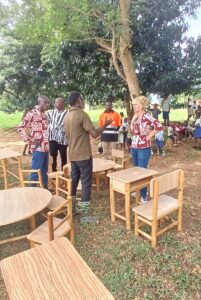
In Accra, there are a few small workshops producing bamboo furniture, mostly simple furniture for terraces or outdoor areas. In fact, I have owned such a bamboo furniture set myself for more than 20 years, a three seater sofa, a two seater and two individual chairs. Even back then, I was fascinated by this natural material. Bamboo always had something warm, natural and at the same time incredibly strong about it. Maybe that was where the very first small seed was planted for what we are building today.
Of course, these workshops became our first point of contact. We visited them, had long conversations and carefully looked at their work. But it quickly became clear that the skills required for what we had in mind were simply not there yet. The furniture was more rough and basic construction work. Perfectly fine for decorative outdoor furniture, but we wanted to create something different.
We wanted to build furniture that children would use every single day in schools. Furniture for hospitals, kindergartens and institutions that needed to be stable, durable and strong enough for everyday use. And that was where the real challenges began.
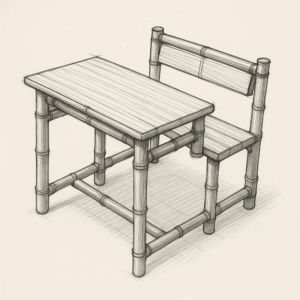
While I was searching in Accra, Victor was doing the same in Kumasi. There as well, we met people working with rattan and bamboo. Beautiful traditional handmade pieces, creative and unique. From a European perspective, many of these pieces would probably be described as summer furniture or lounge furniture. But again, it became clear quite quickly that the technical experience for what we wanted to achieve was missing.
And still, all of these conversations were incredibly important to me.
Because they showed me that bamboo was already known and used in Ghana, but mostly in a very traditional and simple way. I realized that we would not simply find an existing workshop that could already do exactly what we needed. We would have to start building knowledge ourselves. Learning together. Experimenting. Making mistakes and finding solutions.
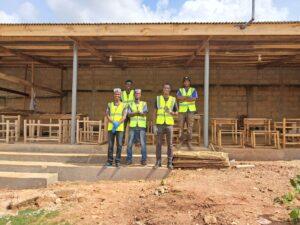
Then came the first tools. The first machines. And eventually, the first bamboo culms we harvested ourselves arrived in our workshop.
And honestly, that was when the real adventure truly began.
Because bamboo is not wood.
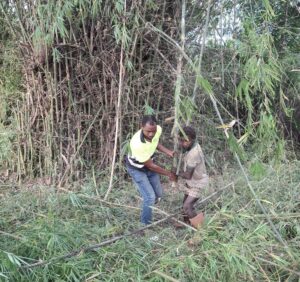
We learned that very quickly. Bamboo reacts differently. It behaves differently. It works completely differently from the material most carpenters are used to working with. The first weeks were almost entirely about experimenting. Some joints did not hold. Some bamboo poles cracked. Others bent or changed shape again. Time and time again we stood there asking ourselves: Why is this not working? What do we need to change?
Looking back, I believe this phase was incredibly important. Not only technically, but also on a human level. We had to learn patience. We had to learn not to give up. And we had to accept that sometimes you do ten things wrong before suddenly something finally works.
One of the biggest learning areas for me was the treatment of bamboo. Untreated bamboo is vulnerable to insects, moisture and mold. So we started diving deeply into these processes. When exactly does bamboo need to be treated? How quickly after harvesting? Which treatment mixture works best under Ghanaian conditions? How should it be stored? How does it dry properly?
At the beginning, many of these things could not simply be learned from books. We had to experience them ourselves and carry them out practically.
And then, one day, came a moment I will probably never forget.
The first finished piece of furniture stood in front of us.
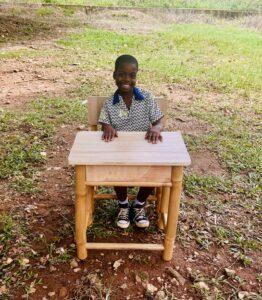
Of course, it was not perfect. Looking back today, I can see many things we would do differently now. But in that moment, none of that mattered. For me, it was an incredibly emotional moment. To see how an idea, so many conversations, doubts, setbacks and countless hours of hard work had finally turned into something real.
For the very first time, I could truly see it:
This can work.


